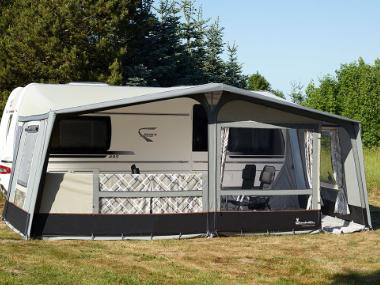
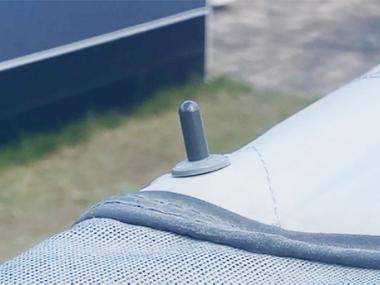
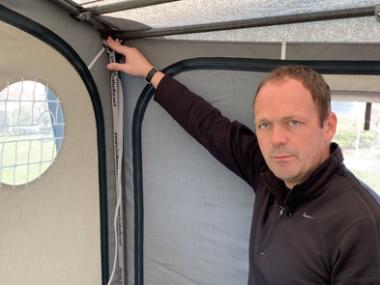
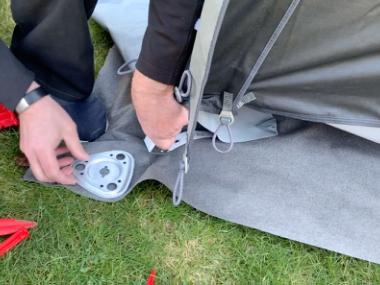
With such strength in frame and canvas, a correctly tensioned Isabella awning is very seldom damaged in stormy weather. All Isabella awnings are supplied with guy ropes to be placed on the corner poles and centre cross. It is important that the guy ropes are placed on the corner poles and centre cross and under no circumstances on roof spikes, canopy hooks or tubes. Neither spikes nor hooks are made for this and they will quickly be destroyed. In addition, most Isabella models are supplied with extra storm guy strips for which special rubber rings can be bought. If the special rings are not used, the storm guy strips will tear. The storm guy strips are not meant to be used for tensioning the awning, the awning will then lose shape. The ropes are to hang down loose so that they will only be tensioned when the wind is blowing. Extra rafter poles can be used in order to secure the awning further. These can easily be fixed by means of the FixOns. Rafter poles and FixOns are available as optional extras. IsaLink storm guy fitting which fits onto all Isabella awnings with storm guy tabs from 1978 onwards, and 30 cm plastic pegs, are available as optional extras from your Isabella dealer.
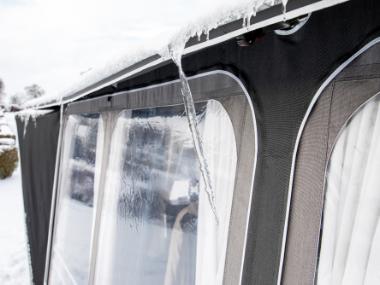
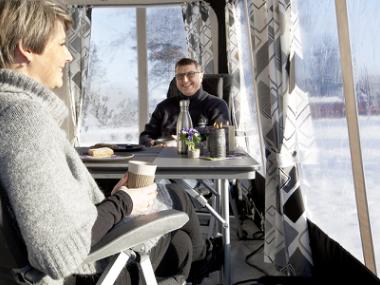
Winter caravanning is becoming more and more popular, and Isabella has a number of winter awnings in the programme. An extra strong frame construction and canvas is common to all three models. The roof material is lacquered which means that snow will slide off easily. A complete winter securing is recommended in areas with excessive snow. Winter securing is available as an optional extra.
All Isabella awnings are supplied with regulator tabs in the corners and feet with spikes, which facilitate a uniform tensioning of the awning and reduce the risk of wear and tear from the poles by minimizing movement against the poles.
The floor area in awnings is usually not quite square, since the awning often is wider at the caravan than the front width. When purchasing a carpet we recommended buying according to the front width (b-measurement) + 50 cm. The optimum fit of the awning to the caravan is achieved when the awning tapers, since the correct tensioning of the roof depends on this. If the awning front is too wide the awnings will often taper beyond the caravan at the rear which will result in a poor fit on the caravan. The UniCut awnings are constructed for modern high caravans, and will often taper more than you are used to on older caravans. Unicut characteristics include higher sides and front and improved roof tension. Varying shapes of caravan mean that UniCut awnings will not always have a symmetrical apparance, a detail outweighted by the superior fit of UniCut.
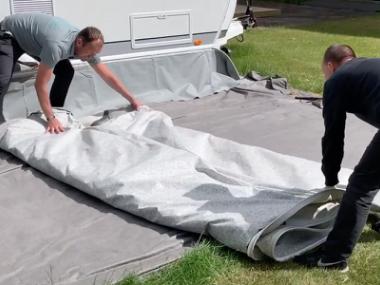
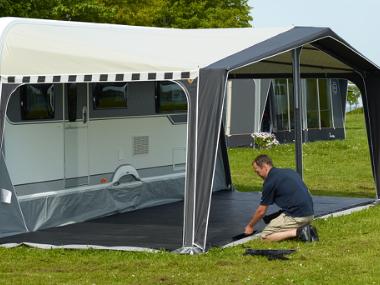
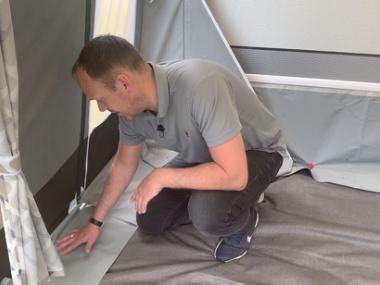
We are regularly contacted by caravanners enquiring about the floor measurements of various awnings with a view to completely finishing the floor and then just erecting the awning as normal. It is not quite so straightforward. We are not in a position to provide exact floor measurements for our awnings when erected. The measurements will vary according to the year and model of the awning and also whether the awning is attached to a slightly taller or squarer caravan, which will reduce the measurements somewhat compared to a more curved caravan of the same size. The only rough measurement that you can base your calculation on is to measure the length of the caravan, add 60 cm and time this figure with the depth of the awning. In this way, you are able to ensure that you have sufficient materials for the floor, but you should expect that the sides have different angles. In fact, the best solution is to erect the awning BEFORE laying the floor (remember to tighten it well), as it is then possible to lay the floor to fit just within the awning skirt, and if required, the exact measurements of the floor could be taken at this point. Naturally, many caravanners will find their own individual solutions, but it is worth bearing in mind that if the floor is too big, it will rub against the awning and potentially rip it, or it may prevent rain water from dripping freely on to the ground. In the event of a major difference in level, the option is to construct a plateau, but the caravan must be on a level with the floor to make it possible to tighten the awning correctly, ensuring an even pull on the rubber straps. Our awnings are produced to fit on to caravans sitting on the ground. If you place a thick floor in front of it, you will reduce the interior standing height, and if you intend to fix the awning to the floor, we recommend that the caravan is raised correspondingly.
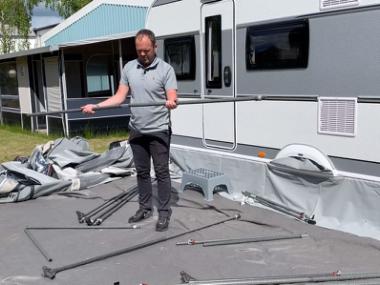
It is advisable to study carefully the assembly instructions of your awning, and you may want to supplement the information provided by logging on to our assembly guidelines and videos on our Web site.
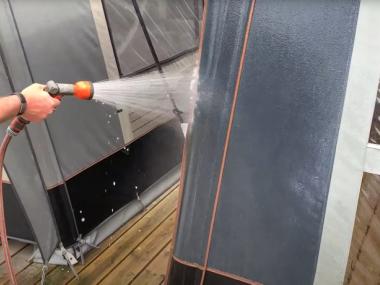
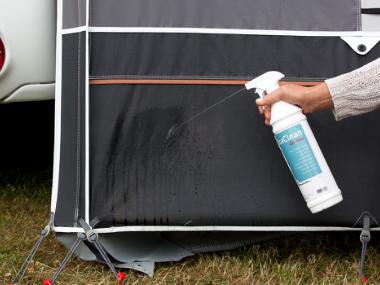
Like Nicotine and cooking, Gas burn off from catalytic heaters can release a substance, which attaches to the awning and provides a breeding ground for mould. Gas heaters in the awning can cause smell, and stains on the inside of the roof. Besides warmth, these Gas burning catalytic heaters can create 1.6 litres water/kg gas. A sticky sulphur/hydrogen compound is created by unburned substances. (Sulphur compound is added to the gas, so that you can smell leaks). When the vapours and the sticky compound add to condensation on the inside of the roof they attract algae and dirt. This looks and smells unappealing. Lots of water and a soft brush can remove 90% of this problem, or use Alpha 123 cleaner, the clean roof should treated with AquaTex spray impregnator. For winter awnings only, an Isabella Inner roof is available.
Determine where you wish to position the awning and take a complete “A” measurement.

For instance if you wish to utilise the door end of the van start at the groundthere, measure up the channel & to the horizontal part of the awning channel, along the roof, out of the channel at the required position and down to the ground. This should measure one of our awning sizes eg 800cm, or 825cm etc. Re-measure until you achieve an equivalent size to determine where the roof will leave the awning channel. Make sure no vents/lockers will be crossed with this side – and that you can fully open the caravan door.
Once positioning of the porch has been confirmed, measure from the ground to the channel of the caravan at the point where the awning roof leaves the caravan channel.
Nick the awning beading at this measurement* on whichever side of the awning will leave the channel. DO NOT CUT THE WHOLE OF THE BEADING, only the thick part that goes inside the caravan channel needs to be cut.
Alternatively, you can break the piping inside the beading using a pair of pliers
You will need to calculate this measurement, taking into consideration that the A measurement of the awning includes approx half the mud wall height.
TIP: To Measure an awning start at the bottom of the pegging elastic at the rear of the awning (on the side panel), follow the white bindle tape up the awning until it meets the beading then measure the beading until you reach the white bindle on the other side, then measure to the bottom of the rear pegging elastic.
The beading on the porch pad, the awning beading and the rear leg are connected using the two Grey "C" strips with double channel. The pad beading is inserted first in the only channel facing the opposite way, the awning beading is inserted in the channel facing the same direction as the leg "C" clip.
The rear leg pole fitting is designed so that the foam pads do not turn. The awning is fitted correctly when the support pole pushes the pad against the caravan, and the awning is fully tensioned. The sides are then fixed against the wind, and that the click profiles surround the support pole. It would be a good idea to turn the 2 plastic profiles (click profiles) opposite to each other.
The screw fitting at the top of the support pole must be fixed, so that the poles push the foam pad completely against the caravan. The support pole must be fitted into the regulator tab at the bottom, and this MUST be tight, so that when the leg is secured with pegs - and maybe a small guy rope, it cannot slide away from the caravan.
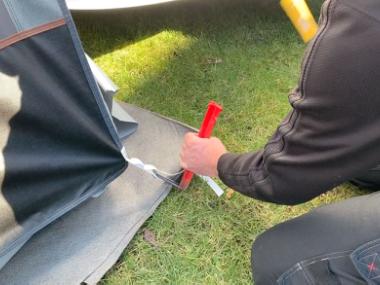
First, the awning is pegged in the back corners to secure the fitting, and then in the front corners. REMEMBER that the regulator tabs must also be tight at the front.
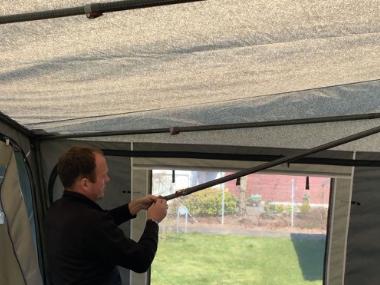
In more extreme weather it would be a good idea to fit the awning with an extra rafter pole in the side - right above the door - from the leg support pole and to the front corner. Thereby the support pole is pushed further against the caravan, and at the same time the screw fitting prevents the click profile from turning around the support pole. The lower click profiles can be locked with loose screw fittings or maybe wire strips. Some caravanners simply put a couple of self-tapping screws through the profile and pole, but in that case be aware that the profiles must be used the same place each time.
Due to the varying shapes and sizes of Caravans it is sometimes necessary to adjust the point at which the Wing triangle of your awning leaves the caravan rail. The natural position, ie where the beading is thinner, can sometimes mean that the triangle is not smooth or does not fit snugly against the caravan side. The caravan sometimes has a wider channel at a higher point. Alternatively the beading can be cut, only cut the white tape containing the piping, and not past the row of stitching. This will accommodate the best possible fit for each caravan style.
CarbonX frame Update!
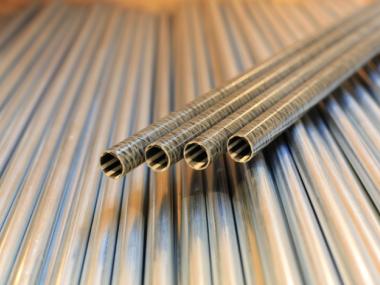
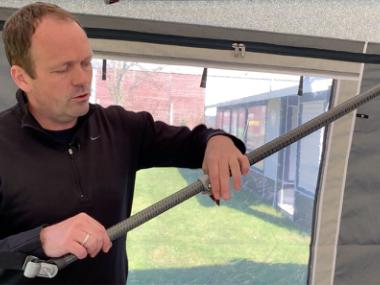
The IsaFix fits easily onto all Isabella frames and replaces the telescopic couplings & wing nuts for easy and effective tensioning of awning frames. The IsaFix comes in two sizes, packed in sets of 3 so that some or all of the frame clamps can be replaced. Simply twist and pull off the existing clamp. Push IsaFix onto the thicker pole (it may be necessary to twist and push, always take care when handling exposed frames - fibre can cause itching). Replace the thinner pole! The IsaFix clamp can be adjusted with a screwdriver for the correct tension
Fibreglass Frame Update!
The Fixus fits easily onto both sizes of telescopic couplings and replaces the wing nuts for easy and effective tensioning of awning frames.